
Lessons from Latvia for Livable Cities: What Is the “Architecture of Our Time” – and PLACE?
As the 63rd International Making Cities Livable convenes in Riga and Jelgava, we will take up this question, applied to some very real case studies – with very real issues for livable cities everywhere

ABOVE: Riga Central Market, considered a notable example of Latvian Republic architecture - although the buildings were created from five Wold War I zeppelin hangars imported from Germany, but fused into a new creative synthesis. (Photo by Guy Percival via PublicDomainPictures.)
RIGA AND JELGAVA, LATVIA - As participants gather here for the International Making Cities Livable (IMCL) conference on July 6-10, a key focus will be on the effects of disruption, displacement and occupation, and the opportunities for regeneration and resilience in their wake.
In this process, one question naturally arises: what does it mean for architecture to express a local identity – an identity not only of a time, but of a place?
This question is especially relevant in Latvia, where the built environment reflects a remarkable sequence of cultural influences, political transformations, and competing visions of modernity. The history of twentieth-century Latvian architecture offers valuable lessons not only about buildings, but about the relationship between culture, memory, and human flourishing.
Latvia's architecture has never been isolated from the wider world. Situated at the crossroads of Northern and Eastern Europe, the country has absorbed influences from German, Scandinavian, Russian, and broader European traditions. Yet the most distinctive achievements of Latvian architecture emerged not from isolation, but from the creative adaptation of these influences into forms that expressed local culture, climate, materials, and aspirations. In that sense, the history of Latvian architecture is not a story of purity, but of synthesis.
And it is a lesson that has relevance for other parts of the world today.

ABOVE: Some examples of the diversity of architecural styles across Latvian history, from (L-R) Russian Empire, Art Nouveau, Soviet Realism, and Modernism. (Photos by the author, except center left by Jean-Pierre Dalbéra via Wikimedia Commons.)
A History Primer: Latvian Architecture from the Russian Empire to the Present
Beginning in the 1700s, Latvia was annexed into the Russian Empire, and Riga was one of its most prosperous cities. In the late 1800s, rapid economic growth, industrialization, and expanding trade fueled an extraordinary building boom. During this period, Riga became one of the world's great centers of Art Nouveau architecture, a distinction it retains today.
Mikhail Eisenstein (father of the pioneering filmmaker Sergei Eisenstein) produced some of the movement's most exuberant and decorative works. In addition, Latvian architects such as Konstantīns Pēkšēns and Eižens Laube helped develop a more distinctly local expression. Their work became associated with the National Romantic movement of the early 20th century, which sought inspiration in Latvian folk traditions, local materials, and regional landscapes.

ABOVE: A building by Konstantīns Pēkšēns and Eižens Laube, designed in 1903, and today the Riga Art Nouveau Center. (Photo by Hans A. Rosbach via Wikimedia Commons.)
The significance of this movement extends beyond its architectural beauty. The National Romantic architects demonstrated that local identity need not reject outside influences. Art Nouveau itself was an international movement, connecting Riga with Vienna, Helsinki, Berlin, Glasgow, and St. Petersburg. Yet Latvian architects transformed these influences into something distinctive. They incorporated native motifs, emphasized local materials, and developed forms that resonated with emerging national aspirations.
In many respects, this period established a pattern that would recur throughout Latvian history: the successful adaptation of international ideas into locally meaningful forms.
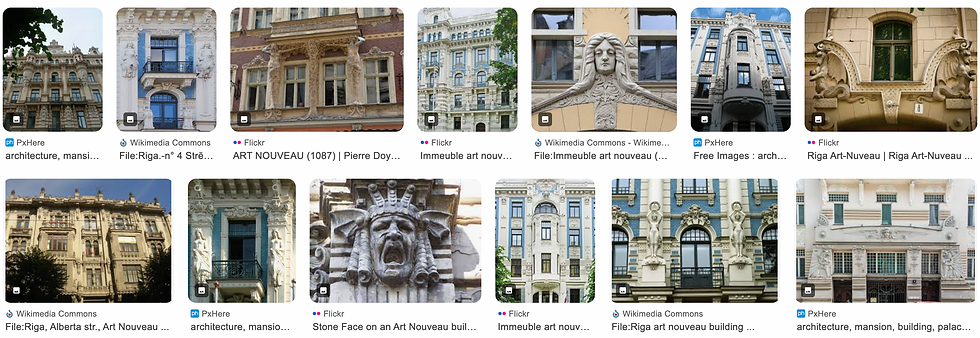
ABOVE: Examples of Riga's more than 800 Art Nouveau buildings, from a Google Images search.
The First Republic and the Search for a National Architecture
Following independence in 1918, the newly established Latvian Republic faced the challenge of expressing nationhood through its institutions and public buildings. Architecture became one vehicle for that effort.

The interwar period did not produce a single national style. Instead, Latvian architects explored a range of approaches, from restrained classicism to early but still decorative forms of modernism, including Art Deco. Government buildings, schools, housing projects, and civic institutions reflected a desire to project stability, competence, and cultural confidence.
Importantly, modernization did not necessarily imply the abandonment of tradition. Many buildings combined contemporary construction methods with familiar proportions, materials, and civic forms. Latvian architecture during this period often sought continuity as well as innovation, creating a dialogue between inherited traditions and new social realities.
This balance between continuity and change remains relevant today. The most successful architectural traditions have rarely emerged from either complete rupture or rigid imitation. Rather, they have evolved by adapting inherited knowledge to new circumstances.
One of the most celebrated achievements of the Latvian Republic was the creation of Riga Central Market, opened in 1930 and still regarded as one of Europe's great public markets. The project was remarkable not only for its scale but also for its ingenuity. The market halls were adapted from former German military airship hangar structures, creating an early and highly successful example of adaptive reuse.
Yet the significance of the market extends far beyond the buildings themselves. By concentrating food vendors, farmers, merchants, and customers within a network of indoor halls and adjoining public spaces, the market created a vibrant civic destination and a powerful engine of local economic activity. It strengthened connections between urban residents and regional producers, supported small businesses, encouraged everyday social interaction, and helped establish a distinctive sense of place.
In this respect, Riga Central Market exemplifies a recurring lesson of successful urbanism: the most enduring projects do not merely provide aesthetically distinctive structures, but create the conditions for public life, economic exchange, and community identity to flourish. (The IMCL conference wiill feature an in-depth tour of the market on Tuesday, the 7th of July.)
War, Occupation, and Stalinist Reconstruction
The Second World War brought tragedy, destruction and occupation to Latvia, beginning with Nazi occupation and then Russian reconquest. Jelgava, in particular, suffered catastrophic damage: much of its historic urban fabric was lost, and its reconstruction became one of the major architectural tasks of the postwar period, continuing to this day.
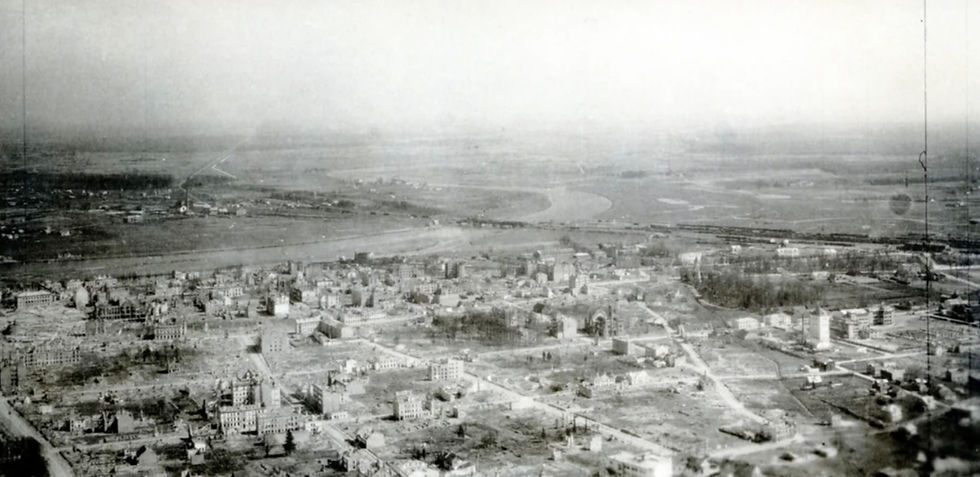
ABOVE: Jelgava in 1945, after catastrophic bombing.
Latvia was annexed into the Soviet Union at the end of the war, and rebuilding proceeded under Soviet political authority. During the late 1940s and early 1950s, architecture throughout the USSR was shaped by the doctrine often known as Socialist Realism or Stalinist Classical architecture. In fact, it was a mandatory style in all Soviet territories between 1946 and 1955.

The Latvian Academy of Science building in Riga, begun in 1951 and finished in 1961. It is characteristic of the Societ Realism style favored by Stalin, sometimes called Stalinist Classicism. (Photo by Nenea Hartia via Wikimedia Commons.)
These buildings featured monumental compositions, symmetrical facades, classical references, and elaborate decorative programs. They were intended to convey permanence, authority, and collective purpose. While deeply associated with an authoritarian political system, they also retained many of the spatial characteristics found in traditional cities: strong street walls, coherent public spaces, visual hierarchy, and richly articulated facades.
As a result, the urban qualities of many Stalinist districts often differed significantly from those that would follow. Whatever their political origins, these environments frequently maintained a degree of human-scaled definition and visual complexity that had characterized cities for centuries.
The 1955 Decree and the Triumph of Standardization
A decisive turning point came in 1955, when the Soviet government issued its famous decree, "On the Elimination of Excesses in Design and Construction." Officially, the decree sought to reduce construction costs, accelerate housing production, and eliminate what were considered unnecessary decorative features. Industrialized building systems, prefabrication, and standardized design became the dominant priorities.

ABOVE: A clear example of the transition from Stalinist Classicism to the International Style, in the Faculty of Forest and Environmental Sciences building at the Latvia University of Life Sciences and Technologies (left) and the Faculty of Environment and Civil Engineering building of the same school (right). Although the building on the left was completed in 1957, its design was begun prior to the 1955 Soviet edict, whereas the building on the right was designed in the 1960s and completed in 1972, refpecting the edict's mandates. (Photos by Michael Mehaffy.)
The effects were profound. Across the Soviet Union, apartment blocks, public buildings, and urban districts were designed according to centralized standards and replicated on a vast scale. Architectural ornament was minimized. Local materials and regional characteristics were eliminated in favor of standard materials (often concrete) and uniform characteristics.
In Latvia, these changes carried a significance that went beyond construction economics. The period coincided with Soviet occupation and a broader effort to integrate the republic into a centralized political and cultural system. The highly standardized architecture that followed the 1955 decree became one visible expression of that system.
It's important to note that the architectural ideas that informed this transition did not originate within the Soviet Union, and they were certainly not associated only with Soviet identity. They had emerged earlier in Western Europe through the modernist movement that originated in the 1920s. It was advanced in the Soviet Union and elsewhere by influential figures including Le Corbusier, who advocated for an "International Style" embracing functional efficiency, industrialized construction, standardized building components, and the rejection of historical ornament. The movement became especially popular in the capitalist United States, promoted by influential architects and university professors like Walter Gropius (Harvard) and Mies van der Rohe (Illinois Institute of Technology).
Modernist design was initially controversial in the Soviet Union, where Stalinist architecture had emphasized monumentality and classical symbolism. However, after Stalin's death, Soviet leaders increasingly viewed modernist principles as compatible with their own goals of rapid housing production, industrial efficiency, and technological progress. The 1955 decree effectively aligned Soviet construction policy with many of the same assumptions that were transforming cities throughout Europe and North America — and later, the rest of the world.
It is therefore notable that, despite their origins in very different political systems, both Western and Soviet planners came to embrace remarkably similar architectural formulas: large superblocks, standardized buildings, separation of uses, and the reduction of local architectural variation in favor of an internationally standardized design aesthetic.
The result was not simply modernization. It was also a weakening of architectural differentiation and local identity. Buildings in Riga, Jelgava, Minsk, Kyiv, or Novosibirsk — along with buildings in Chicago, New York and soon the rest of the world — increasingly shared the same architectural vocabulary, regardless of differences in history, culture, climate, or landscape.

ABOVE: Jelgava's traditional wooden buildings (far left) and Riga's distinctive assemblage of stretscape buildings (center left) evoke a strong sense of local identity, whereas the same cannot be said for the International Style mandated by Soviet law after 1955 (center right and far right). (Photo at left by City of Jelgava, others via Wikimedia Commons.)
Today, Latvia has decisively rejected the Soviet political project associated with that era, along with its architecture. Along with the symbolic associations they bring, many of the buildings are poorly insulated, uncomfortable, and energy-inefficient. It is widely recognized that these buildings need to be retrofitted at least, if not demolished and replaced.
This raises an important question: how should these inherited districts evolve in the future? Is it just the symbolism and identity we should consider for new buildings and their aesthetic characteristics — or should we consider other factors too?
What Contemporary Research Is Telling Us
Recent decades have produced a growing body of research that sheds light on this question. Studies in urban design, environmental psychology, public health, and complexity science increasingly suggest that certain recurring characteristics of traditional urban environments support positive human outcomes.
Although the findings are scattered across disciplines, a common theme emerges. Human beings respond positively to environments that provide coherent spatial structure, visual richness, identifiable centers, clear boundaries, and opportunities for social interaction. Features such as articulated facades, visible entrances, rhythmic repetition, transitional spaces, and richly connected public realms are associated with increased walking, stronger social engagement, improved orientation, and greater attachment to place.
Many of these qualities are commonly found in traditional buildings and urban districts—not because earlier architects possessed modern scientific evidence, but because successful forms were refined through long processes of cultural adaptation and practical experience.
This does not mean that every historical building is exemplary, nor that contemporary architecture should simply replicate particular buildings of the past. It does suggest, however, that many traditional patterns embody forms of accumulated knowledge that remain highly relevant and useful today. And it suggests that the taboo of "we mustn't use the forms of the past" is itself out of date, and even inconsistent with contemporary insights from evolutionary science.
Toward an Emerging Latvian Identity for Today
What, then, might a contemporary Latvian architectural identity look like? History suggests that the answer is unlikely to be found in either a universal international style, or a strict reproduction of historical forms. Latvia's most successful architectural periods were neither isolated nor derivative. Rather, they adapted influences from many sources, while transforming them into expressions of local culture and circumstance.
The architects of Riga's Art Nouveau era borrowed from international movements, but they went on to create something distinctly Latvian. The National Romantic movement drew upon folk traditions while participating in broader European currents. Even earlier vernacular traditions reflected centuries of exchange across the Baltic region.
In this sense, local identity is not a fixed artifact waiting to be rediscovered. It is an ongoing cultural process of transfer, revival, adaptation, addition and refinement. It is an evolutionary process.
For cities such as Jelgava, the challenge is not merely to preserve what remains, or to reject what was inherited. It is to continue the work of this adaptation: drawing upon historical knowledge, contemporary research, local traditions, and new technologies to create places that are more humane, more resilient, and more deeply rooted in their communities.
The most successful future architecture for Latvia may well combine elements from many sources — as it has throughout its history. What matters is not where (or when) an idea originated, but how well adapted it has become, and how effectively it contributes to the life of a particular place.
Seen in this light, local identity is not something that can be mandated from above, nor imported wholesale from elsewhere. It emerges from the interaction of culture, memory, environment, and human need. It is also temporal, expressing unique hallmarks of its own time, while also incorporating timeless and universal characteristics. Like a living city itself, it is never finished, but continually renewed, through the creative work of each generation.
---
The 63rd International Making Cities Livable will include a workshop to study options for the regeneration of portions of Jelgava, Latvia. Attendees are encouraged to contact the director, Michael Mehaffy, to discuss their participation.


