
ONE MONTH To Historic 63rd International Making Cities Livable (IMCL) Conference in Beautiful Latvia
Updated: Jun 5
Preparations are in place for a content-rich gathering, featuring study tours, receptions, workshops and much more; livable city topics include affordability, walkability, economic opportunity, resilience, artificial intelligence in design, and many more timely issues for cities and towns.

ABOVE: Left and center, IMCL Board Members Jim Brainard and Michael Mehaffy meeting recently with staff at Riga's very beautiful House of the Blackheads, where the opening reception will be held; Above right, making a video about the splendid Jelgava Palace, where the main conference sessions will be held; second row, left, meeting with Riga City Architect Peteris Ratas (center) and Riga Mayor Viesturs Kleinbergs; center, meeting with Jelgava Mayor Mārtiņš Daģis, staff, and officials of the Latvia University of Life Sciences and Technologies (our hosts and partners); and right, meeting with guides who will provide several study tours on Monday and Tuesday, July 6th and 7th.
RIGA AND JELGAVA - With just one month to go, preparations for the 63rd IMCL conference are nearly complete. Attendees will be treated to a rich program of events:
Welcome session by the City of Riga;
Study tour of the city core;
Study tour of the turn-of-century and Art Nouveau areas;
Opening reception at the splendid House of the Blackheads, including a tour of the historic building and its centuries of history;
Study tour of the amazing Riga Central Market — Europe's largest — with over 3,000 stalls in 780,000 square feet of converted zeppelin hangars;
Transport to and study tour of the city of Jelgava, including its historic Old Town Street Quarter of distinctive wooden buildings, and its Soviet-era buildings that are slated for regeneration;
Welcome reception at the historic Jelgava Palace, our venue for the regular sessions of the conference;
Three days of plenaries, breakouts, and workshops, including a workshop on AI in design, a drawing workshop, and a workshop on the regeneration of a portion of Jelgava;
An optional awards dinner at the Jelgava History and Art Museum;
A final plenary with discussion and debate, followed by a closing reception at Jelgava Palace;
Abundant opportunities for side tours, cultural events, and other immersive experiences.
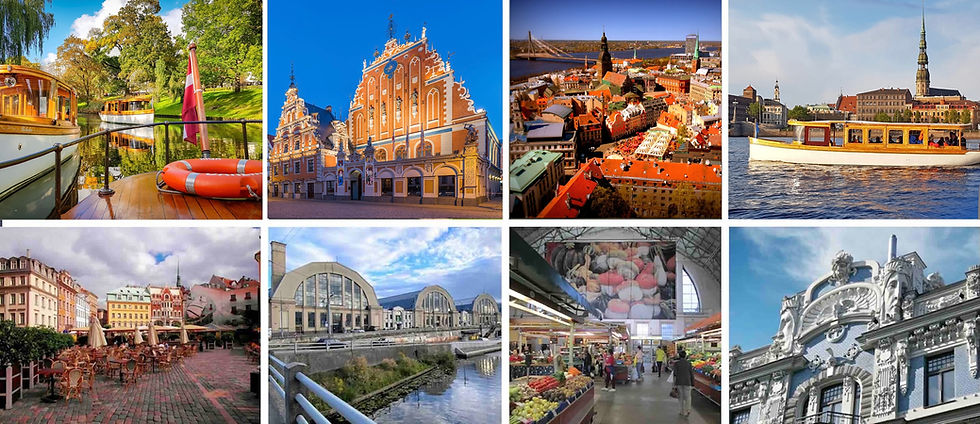
ABOVE: Some of the delights, and the urban lessons, of Riga.
The conference comes at an especially challenging moment for cities around the world. Under the theme “Regenerative Architecture and Urbanism: Recovery and Resilience After an Age of Disruption,” the conference will bring together urban leaders, architects, planners, scholars, developers, public officials, and NGO representatives to examine how cities can respond positively to a period marked by environmental stress, geopolitical instability, economic uncertainty, technological disruption, and social fragmentation.
This is certainly not the first time in history that cities have been under stress — and the study of that history, in places like Latvia, offers us many useful lessons today. Among them is how to use a time of disruption to build better, and to recover city quality of life, ecology, opportunity, durability, sustainability — and livability for all.

ABOVE: Some of the sights of Jelgava, including the Jelgava Palace, the Holy Trinity Church Tower with the distinctive restaurant 8 stavs, and the distinctive wooden houses of the historic Old Town Street Quarter.
Participants will experience two complementary urban settings: Riga, one of Europe's great historic capitals and a UNESCO-recognized center of architectural heritage, and Jelgava, a city that has undergone extensive post-war reconstruction and continues to grapple with questions of regeneration, identity, and resilience.
The conference theme reflects a growing recognition that cities must move beyond merely "sustaining" existing systems, and toward actively regenerative approaches that rebuild ecological health, social capital, economic vitality, and cultural continuity. A central question is how communities can adapt to rapid change without sacrificing local identity, heritage, and human-scale urban qualities. Latvia offers an especially compelling setting for these discussions: situated at the crossroads of major historical and contemporary geopolitical forces, the country has repeatedly confronted disruption, occupation, destruction, and renewal. The resulting urban landscape provides valuable lessons about recovery, adaptation, and the enduring importance of place-based culture.
A distinctive feature of the Riga–Jelgava conference will be its emphasis on learning directly from real places. Participants will engage with historic districts, public spaces, regeneration projects, and urban neighborhoods through a number of guided tours and workshops, examining how urban form, architecture, public life, and governance interact to create resilience. Rather than focusing solely on abstract theory, the conference seeks to connect research with practical implementation, exploring how successful patterns and strategies can be applied in cities and towns facing similar challenges worldwide.
The conference is also notable for its broad international and interdisciplinary participation. IMCL has long served as a forum where practitioners and scholars from multiple fields can engage directly with one another, bridging gaps between research, policy, design, development, and civic leadership. Partners and participants are expected from organizations including UN-Habitat, the King's Foundation, the Congress for the New Urbanism, INTBAU, universities, municipalities, and numerous civic organizations, including those from Latvia. This diversity of perspectives is especially valuable at a time when many urban challenges—housing affordability, climate adaptation, social cohesion, economic resilience, and heritage conservation—cannot be solved within professional silos. We need a "joined-up" approach.
For prospective attendees, the conference offers a unique opportunity for professional and personal development — not only to learn about emerging approaches to regenerative urbanism, but also to build professional relationships and collaborations across continents. In an era when urban professionals are searching for practical strategies that can bridge the gap between aspiration and implementation, the IMCL conferences provide both intellectual inspiration and actionable knowledge. The setting of Latvia—combining a rich architectural heritage, a history of resilience, and an active process of contemporary urban transformation—makes it an especially fitting place to explore how cities can recover from disruption, while building stronger, more beautiful, more durable cities, towns, and countrysides.
For more information, please visit https://www.imcl.online/latvia.

Thanks to our wonderful sponsors and partners!


