
What Can We Learn from Riga, Latvia, "One of the Top Walkable Cities in Europe"?
The city offers many lessons in shaping streets and paths, "outdoor rooms," and appealing architectural details
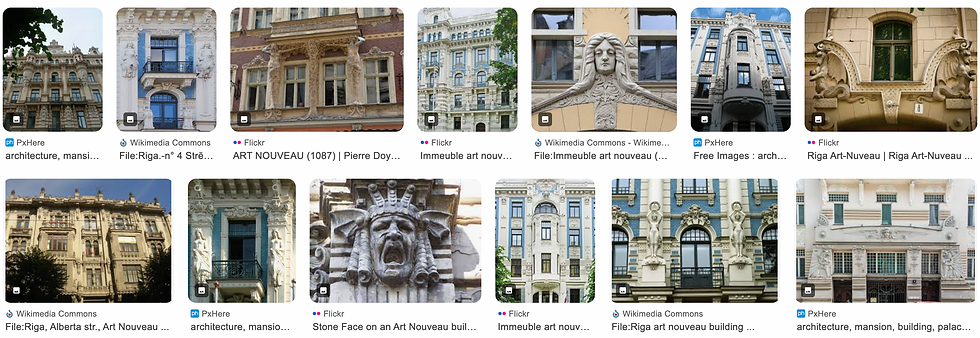
ABOVE: Just some of the architectural treasures of Riga, Latvia — in this case, its remarkable collection of Art Nouveau architecture — making it an exemplar case study of walkability.
RIGA, LATVIA - When a city like Riga is named among Europe's most walkable — as was recently the case for Riga by Forbes, Time Out, and others — it is tempting to attribute the recognition to accidents of history. But that would miss the deeper lesson. Walkability — real, lived walkability — is not an accident, but an achievement. It is the outcome of the intentional development of spatial patterns, cultural practices, and institutional frameworks that reinforce one another over time.
For participants in the upcoming IMCL conference (July 6-10), Riga offers something more than a beautiful and inspiring destination — though it certainly is that. It is a working laboratory: a place where we can observe how a city integrates heritage, mobility, public space, and recovery into a coherent urban fabric. In an era defined by disruption — pandemics, geopolitical instability, climate stress — this is precisely the kind of system we need to understand.

ABOVE: Some of Riga's walking delights that we discovered on our preparation trip in February.
The same is true for the nearby city of Jelgava, where we will be gathering at the splendid Jelgava Palace. That city faces different challenges, owing to its near-destruction during World War II, and the construction of Soviet-era buildings that the city is keen to regenerate. The goal is also a more walkable, livable, successful city, and the City is eager to tap into the knowledge and insights of conference participants.

ABOVE: Our conference venue, Jelgava Palace.
Walkability as a Network Property
Too often, "walkability" is reduced to a checklist: wider sidewalks, fewer cars, more crossings. Riga demonstrates a more sophisticated reality. Walkability emerges from a dense network of interconnected places — what might be called a "place network." The city's destinations are close together within a fine-grained urban fabric, diverse in function with shops, housing, and culture interwoven, and visually legible through clear edges, landmarks, and spatial sequences. The result is not simply that one can walk — but that one wants to walk. The city invites exploration through a continuous sequence of spatial rewards. This is precisely the IMCL emphasis in action: cities understood as systems of relationships, not isolated interventions.

ABOVE: Riga's walkability is reinforced by a network of destinations, including the spectacular Central Market, one of Europe's largest (below left and right). The walkable range is extended by a network of convenient transportation choices.
Architecture as Infrastructure
Riga's globally renowned collection of Art Nouveau buildings (photo at top) is often treated as a cultural asset — and it is. But it is also something more fundamental: a form of cognitive and perceptual infrastructure. These buildings exhibit many of the properties identified by Christopher Alexander — hierarchy, symmetry, levels of scale, deep reveals, coherent rhythms — coming together to form an environment that sustains visual interest over long walking distances, providing orientation cues and memorable landmarks, and encouraging lingering, social interaction, and repeated visits. Contrast this with many contemporary environments characterized by what we might call "geometrical fundamentalism" — blank, repetitive, or jagged forms that fail to engage human perceptual systems, actively discouraging walking even when distances are short. In Riga, architectural richness is not an optional aesthetic layer. It is a functional component of walkability itself.

ABOVE: Architectural support for walkability can be seen in the two Riga examples at left - and missing in the two examples at right.
The Continuity of the Public Realm
Another key lesson is the continuity of the public realm. Streets, squares, parks, and waterfronts in Riga are not isolated amenities — they form an integrated system in which green spaces connect seamlessly to urban streets, waterfronts are accessible and inviting, and public squares anchor social and civic life. A choice of convenient and reliable public transportation extends this walkable realm into a "polycentric" city.
This continuity creates an overlapping network of public spaces facilitating social connections, which research has shown is a critical feature for urban resilience. For IMCL attendees focused on the theme of urban recovery, this is not merely an aesthetic observation. Cities that function as connected systems are far better able to adapt than those composed of disconnected fragments.
Time as a Design Partner
Riga's urban fabric is not the product of a single plan or era. It is a layered system, evolving over centuries through incremental adaptation — producing a diversity of building types and uses, flexibility for changing economic conditions, and an embedded cultural memory that no master plan can manufacture. Many modern developments, by contrast, are built as large monolithic projects with limited adaptability. When conditions change, as they inevitably do, these environments struggle to respond. Riga shows the value of what we might call "time as a design partner." Its resilience is inseparable from its capacity to evolve incrementally.
Affordability, Diversity, and the Limits of Success
One of Riga's most consistent recent accolades is its status as a high-value, relatively affordable European destination — one publication calls it "a wildly underrated city" — and this is not incidental to its walkability. Walkable urban environments tend to generate high demand, but if costs rise too steeply, they can undermine their own social and economic diversity. Riga appears, at least for now, to maintain a productive balance: high-quality urban form, relatively accessible costs, and a mix of local and international users that sustains a lively, mixed urban population. For practitioners, the lesson is clear — walkability must be paired with policies that sustain diversity and access, or it risks becoming self-limiting.

ABOVE: Walkability is promoted by subtle shifts of street alignment, producing "deflected views" and teasing interest in what's ahead. It's also enhanced with landmark buildings, like Riga's opera house, the Latvian National Opera (upper left) and the Riga Cathedral, founded in 1211.
A Baltic Case Study in Recovery
Perhaps the most compelling lesson for IMCL attendees lies in Riga's broader regional context. Latvia, like its Baltic neighbors, has undergone profound disruptions — Soviet occupation and centralized planning, economic restructuring after independence, integration into the European Union, and more recent geopolitical tensions. And yet Riga has emerged as a city of increasing stability, attractiveness, and global recognition. This suggests that urban form and public space matter in recovery and ultimate success, and that cultural continuity provides a foundation for resilience. For a conference devoted to regeneration in a time of disruption, Riga is not just an illustrative example — it is a case study actively unfolding before our eyes. And that is especially true in this moment of European and global history, as Europe takes on a stronger leadership role — and that is true for its leadership in livable cities.
An Invitation to Look Closely
For those attending the IMCL conference, Riga and Jelgava offer a rare opportunity: to experience walkability as a lived system rather than an abstract metric, to observe the integration of heritage and contemporary life, and to study how public space networks support urban resilience. Being ranked among Europe's most walkable cities is an achievement — but it is also a signal, pointing to deeper structural qualities that are increasingly recognized as essential for livable, resilient urbanism.
For more information on the IMCL conference, please visit https://www.imcl.online/latvia.

ABOVE: Capping off our preparatory tour at the House of the Blackheads in Riga.


